WORKING PAPERS
Raja, Sinduja. 2025. Beyond the State: Social Movements, Welfare Ecosystems, and New Political Subjectivities in Mexico and India (Under Review).
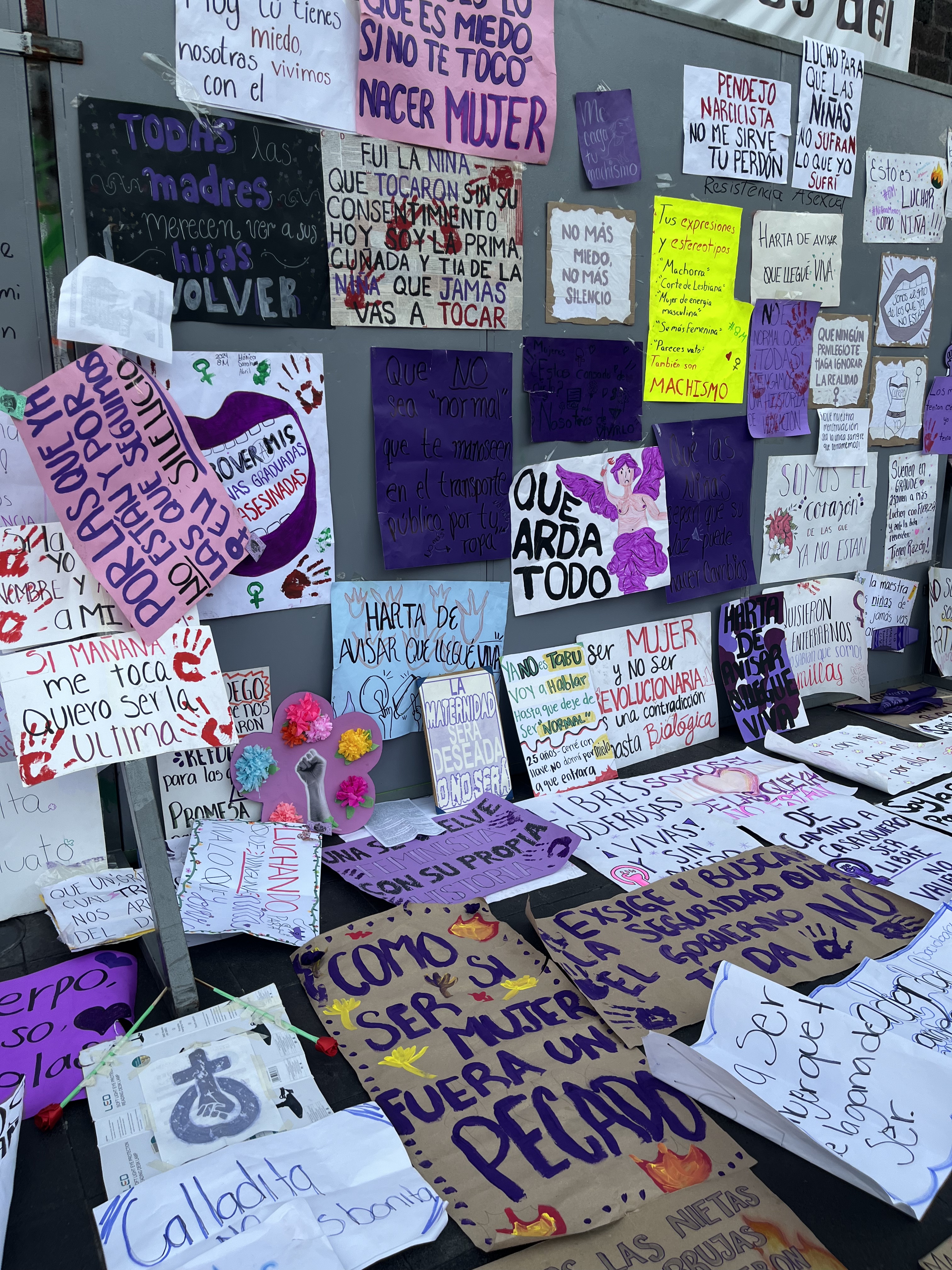
Abstract: In the past decade, social movements worldwide have emerged to challenge their states on authoritarianism and gendered oppression. This article examines how reformist movements created to demand change through the state instead came to disavow it, transforming participants into critics of state-based reform. Drawing on 109 qualitative interviews from two movements—the Okupa Cuba occupation in Mexico City and the anti-CAA/NRC movement in New Delhi—I identify three mechanisms through which participants developed this new political subjectivity: political recognition, political substitution, and political transcendence. Both movements, despite violent suppression and official “failure,” provided participants with welfare ecosystems including childcare, healthcare, food distribution, education, and legal aid. These practices sustained the movements while reshaping participants’ expectations of the state, fostering self-reliance, community-based welfare, and horizontal democratic participation. I argue these trajectories are crucial for understanding social movements and state-society relations: they reconfigure democracy’s terrain toward grassroots, collective life, generating durable transformations.
Raja, Sinduja. 2025. Securitized Resistance: new logics of security and protection in social movements (Under Review).
Abstract: In the past few decades, several progressive social movements worldwide emerged under high threat of repression and violence by their governments and other detractive actors. This article examines how such high-risk movements protect themselves from threat of repression and how these protection mechanisms shape their relationship to the movement and their political engagement. Using 109 qualitative interviews from two movements—the Okupa Cuba movement in Mexico City and the anti-CAA/NRC movement in New Delhi—I propose that high-risk movements create security and safety measures that leads to a “securitization of resistance”. Considering the different self-protection mechanisms undertaken within the movements in Mexico and India, I show that this securitization of resistance is hybrid in nature–on the one hand, following state-based and top-down security measures such as surveillance, bordering, etc. and on the other, creating security communities that prioritize their future safety and well-being independent of the state. I argue that this securitization of resistance displays both short-term and long-term needs of participating communities, shaping their engagement with safety, care, and community well past the end of the movements.
Raja, Sinduja. 2025. Women’s Rights After War: reading harm on paper (with Milli Lake).
In the last few decades, a number of countries emerging from conflict enacted a spate of women’s rights reforms because they viewed the advancement of women’s rights as a way to right past wrongs, and to signal to global audiences that they were growing into peaceful post-war democracies. While many studies have attempted to study the effects of implementation of these reforms, we argue that the content and meaning of the laws by themselves create and reiterate harm even prior to implementation. We draw on our original qualitative dataset of gender-progressive laws across four issue areas and six country cases and posit that, by privileging a particular archetype of ‘woman’ that is structured around patriarchal, colonial, and capitalistic logics, legal and policy reforms have a tendency to reproduce self-undermining stereotypes at the outset, even prior to any challenges of implementation. When this foundational harm interacts with implementation challenges, already peripheralized populations are rendered even more marginalized, and deep-seated political harms can become more firmly institutionalized. Therefore, many gender sensitive legal reforms can only offer a starting point to provide important in-roads for women to gain political recognition, especially when they present women in unidimensional and patriarchal ways.
PUBLISHED WORK
Lake, Milli, Marie E. Berry, Sinduja Raja and Soraya Zarook (2025) ‘Hierarchies of Violence, Victimhood, and Remedy in the Pursuit of Women’s Rights After War’. Global Studies Quarterly 5 (2).https://doi.org/10.1093/isagsq/ksaf051.
Anumol, Dipali, Sinduja Raja, and Q Manivannan. July 2025. ‘The Politics of Care: Mapping emancipatory futures in/beyond institutions’. In the A Contemporary Reader of Feminist International Relations., edited by Catherine Goetze and Khushi Singh Rathore. Routledge International Handbooks. New York: Routledge.
Raja, Sinduja (2023) Women’s Rights After War on Paper: An Analysis of Legal Discourse,
Journal of Genocide Research, DOI: 10.1080/14623528.2023.2212511
Raja, Sinduja (2024) Review of ‘Twelve Feminist Lessons of War’. By Cynthia Enloe. Oakland: University of California Press, 2023. 224 Pages. Peace and Change 49 (3): 293–95. DOI: 10.1111/pech.12668.
Q Manivannan, Dipali Anumol, Sinduja Raja, Dipti Tamang, Khushi Singh Rathore, Emma
Louise Backe, and Laura J. Shepherd (2023) Care conversations, International Feminist Journal
of Politics, 25:2, 336-352, DOI: 10.1080/14616742.2023.2190341
Raja, Sinduja, Marie E. Berry , and Milli Lake. Research Brief: Women’s Rights After War.
Folke Bernadotte Academy. December 2020.
Datasets
Berry, Marie E., Milli Lake, Sinduja Raja, and Soraya Zarook. Post-war Gender Reforms Dataset. Published August 2022. Distributed by Women’s Rights After War, The Gender, Justice, and Security Hub.
 sindujaraja.org