My Research
My dissertation rethinks the relationship between social movements and democratic change by moving beyond movement outcomes to examine the internal structures and democratic practices that movements themselves generate. My project aims to answer three central questions: (A) Why do social movements develop such elaborate internal infrastructures, often unrelated to their stated goals? (B) How do these infrastructures contribute to the goals of the movement, and (C) How do they transform participants’ political and social lives during and after mobilization?
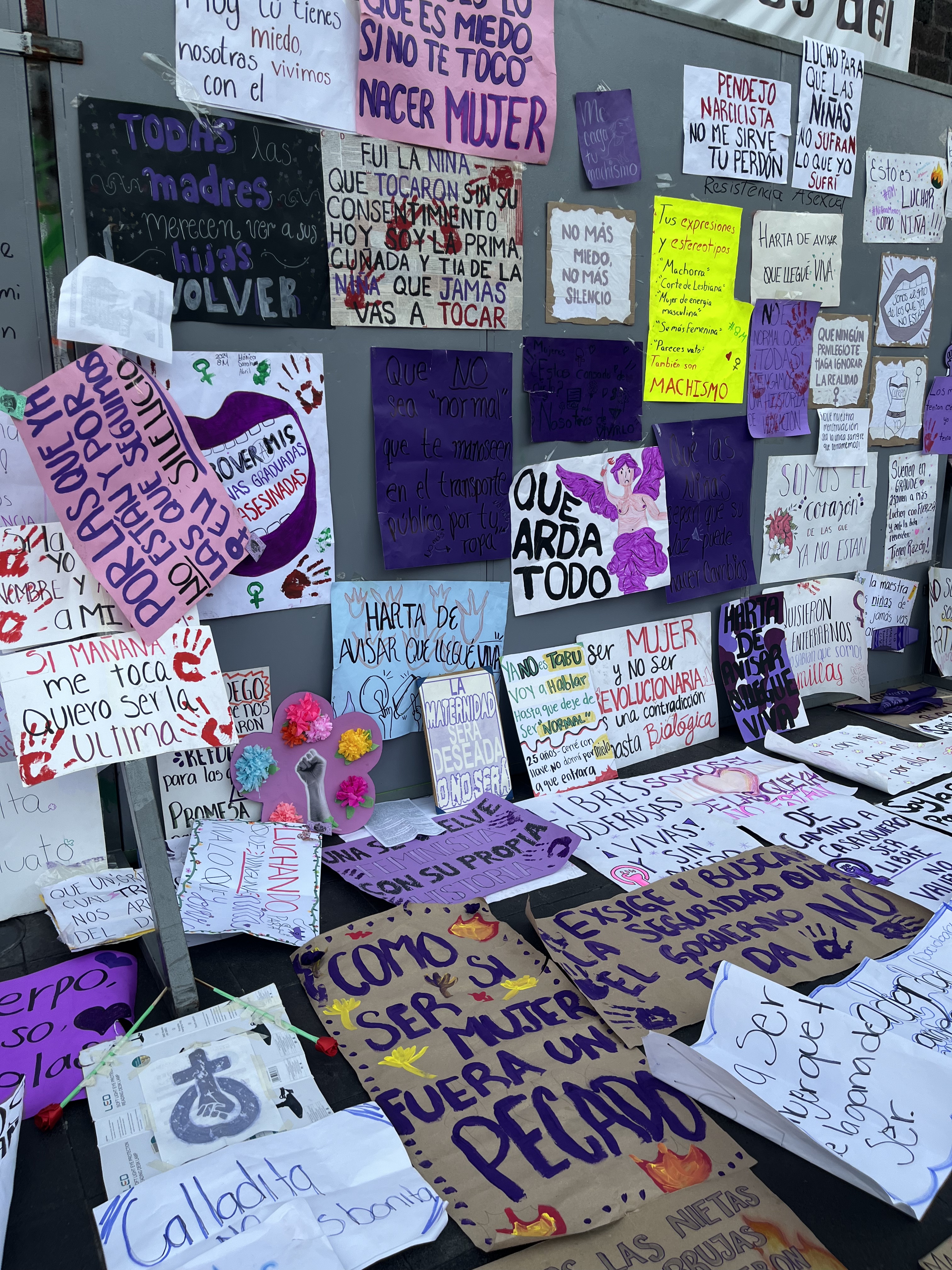
To address these questions, I adopt an interpretivist and multi-scaled comparative approach. My case studies focus on two distinct movements: the Okupa Cuba Casa Refugio (Okupa) movement in Mexico City (2020-2021), a micro-level movement protesting government inaction on violence, and the Anti-CAA/NRC protests at Shaheen Bagh, New Delhi (2019-2020), a meso-level movement opposing discriminatory citizenship laws in India.
The Okupa Cuba movement emerged in 2020 in response to the Mexican government’s failure to address pervasive violence. A group of women protested the National Human Rights Commission (CNDH) for its inaction on the cases of their missing and killed family members. They took over the CNDH building in Mexico City, transforming it into a shelter for victims of violence. They created horizontal, leaderless structures, mutual aid systems, and communal decision-making processes, demonstrating grassroots efforts to establish democratic spaces in the face of state apathy. The Shaheen Bagh protest in New Delhi was a response to the Indian government’s Citizenship Amendment Act (CAA) and National Register of Citizens (NRC), which threatened to disenfranchise Muslim citizens. Led primarily by Muslim women, this movement created an ecosystem that provided community kitchens, libraries, daycare centers, and other essential services.
I argue that these infrastructures emerge as marginalized participants identify and address underlying political and social grievances that are often at the root of the movement’s stated goals, even as they extend beyond them. They take shape across three domains: welfare systems that address material needs the state fails to meet, security systems that protect participants from violence, surveillance, and retaliation, and spatial governance systems that coordinate collective decision-making and the governance of shared public space and operate through three mechanisms: recognition, through which participants name structural harm and assert collective claims; substitution, through which communities provide in place of the state; and consolidation, through which new democratic practices are carried beyond the moment of protest itself. Through these processes, movements cultivate new political subjectivities, as individuals assume roles of governance, care, and authority that reconfigure their relationships with the state and with each other. These shifts endure beyond mobilization, shaping participants’ political trajectories, everyday practices, and imaginaries of justice.
By centering these internal infrastructures, the project reconceptualizes movements as alternative democratic orders rather than just contentious action. Rather than evaluating movements solely by their impact on policy or institutional reform, I show how they enact democratic transformation through egalitarian, relational practices that sustain political life when state institutions collapse or exclude participants. In doing so, the project challenges state-centric understandings of democracy that equate its vitality with electoral institutions or formal governance structures
Through my project, I advance the literature on social movements by focusing on their internal dynamics and the broader impacts on movement participants, beyond measurable policy outcomes. I critique traditional social movement theories that often define success based on policy change or institutional impact, and instead, I explore how movements can foster social and political transformations within communities directly. By creating alternative systems, such as mutual aid networks, movement participants meet their needs independently of the state while simultaneously enacting democratic values. My research highlights the potential of social movements to reshape state-society relations and demonstrate new forms of political power.
 Sinduja Raja